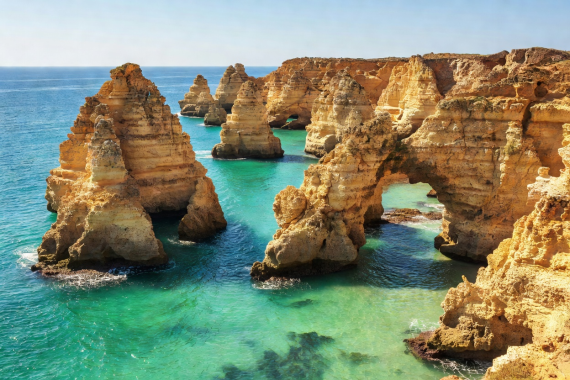
The Miocene Calcarenite Geology of the South
The Algarve is broadly divided into two geological identities: the Sotavento (eastern Algarve from Faro to the Spanish border), characterized by barrier islands, sandy lagoons, and the Ria Formosa natural park; and the Barlavento (western Algarve from Albufeira to Sagres), celebrated for its dramatic golden karst cliff faces. The cliffs around Lagos and Benagil consist of Miocene-epoch fossil-rich calcarenite and bio-calcarenite limestone.
Over millions of years, the mechanical energy of Atlantic winter storms combined with rainwater dissolution created a spectacular subterranean network: collapsed sea vaults, sinkholes (algares), and monumental sea pillars (leixões). The most celebrated marine feature is the Algar de Benagil, an immense vaulted sea cathedral illuminated by a natural circular skylight opening in the cliff ceiling.
Lagos: Maritime Heritage and Ponta da Piedade
Lagos is not merely a resort center; it is a fortified maritime harbor steeped in 15th-century Age of Discovery history. It was from Lagos that Gil Eanes set sail in 1434 to round Cape Bojador, breaking medieval European superstitions regarding the Atlantic unknown.
Just two kilometers south of Lagos's walled old quarter lies Ponta da Piedade. A headland crowned by a working lighthouse, it provides a breathtaking cliff-top boardwalk offering views across turquoise water. A 182-step stone stairway descends to the ocean baseline, where local wooden motorboats navigate narrow marine gorges that motorized catamarans cannot enter.
Safety Advisory: Coastal Cliff Stability
Due to ongoing marine erosion, limestone cliffs across the Algarve are susceptible to sudden rockfalls. Always observe warning signs posted on beaches. Never sunbathe directly below overhanging rock faces, and remain behind marked wooden handrails when walking cliff-top trails such as the Seven Hanging Valleys pathway.
Top Beaches of the Western Algarve
Every beach along the Barlavento offers distinct topography and shelter profiles:
- Praia do Camilo (Lagos): Reached via a steep wooden stairway of 200 steps cutting through red sandstone. The beach is split in two by a man-made hand-hewn tunnel through the cliff wall.
- Praia da Marinha (Lagoa): Widely recognized as one of the world's most beautiful beaches, flanked by towering yellow cliffs, natural double arches (M-rock), and rich snorkeling habitats.
- Praia de Dona Ana (Lagos): Sheltered from prevailing northerly winds by protective headlands, making it exceptionally suited for stand-up paddleboarding and sea swimming.
The Untamed Frontier: Sagres & Cabo de São Vicente
Continuing westward past Lagos leads to the end of the European continent at Cabo de São Vicente and the Fortaleza de Sagres. Here, the warm Mediterranean ambiance of the central Algarve dissolves into an austere, treeless plateau battered by relentless Atlantic gales.
The cliffs drop vertically 75 meters into deep ocean swells. The lighthouse at Cape St. Vincent houses one of Europe’s most powerful optical lanterns, projecting a beam visible for nearly 60 kilometers out to sea to guide international maritime cargo navigating between Northern Europe and the Mediterranean.