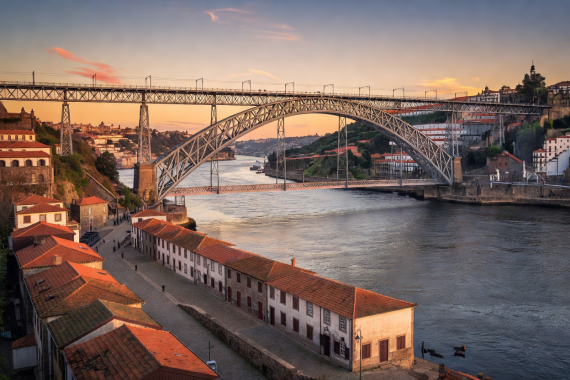
The Granite Fabric of Porto
Porto, the ancient Portus Cale from which the country derives its name, presents a starkly different physical presence than Lisbon. Where Lisbon is formed of luminous limestone, Porto is carved from dark grey Hercynian granite. The city rises sheer from the banks of the Douro River, its tightly stacked baroque facades, medieval bell towers, and wrought-iron balconies creating a dramatic vertical cityscape.
The heartbeat of the city is the Ribeira, a UNESCO World Heritage urban quarter where pastel townhouses hug the waterfront. Directly overhead spans the monumental double-deck Ponte de Dom Luís I, engineered by Théophile Seyrig, a co-founder of the Eiffel company. Walking across the upper deck—some 45 meters above the churning river waters—offers an unrivaled aerial perspective over Porto’s terracotta roofs, São Bento Station, and the towering Sé Cathedral fortress.
Vila Nova de Gaia and the Port Cellar Caves
Crossing to the southern bank of the Douro brings travelers to Vila Nova de Gaia. By royal decree dating back to the 18th century, all Port wine produced in the upstream Douro Valley had to be aged and barreled here, where proximity to the Atlantic Ocean provided optimal cool temperatures and stable humidity. Today, historic lodges such as Taylor's, Graham's, Cockburn's, and Sandeman maintain vast subterranean networks holding thousands of seasoned oak casks (pipas).
Understanding Port wine requires distinguishing between the two primary aging methodologies:
- Ruby Styles (including Vintage and LBV): Aged primarily in large wooden vats or bottle glass with minimal oxygen contact, retaining intense blackberry, dark fruit, and tannic vibrancy.
- Tawny Styles (10, 20, 30, and 40-Year Indications): Aged for decades in smaller 550-liter oak pipas, undergoing gradual oxidative maturation that transforms the hue to amber-tawny and imparts rich notes of dried figs, toasted walnuts, and caramel.
Venturing Inland: The Alto Douro Demarcated Region
The true majesty of Portugal’s viticultural soul lies 100 kilometers inland in the Alto Douro, demarcated in 1756 under the Marquês de Pombal, making it the oldest formal wine appellation on Earth. Here, the river cuts deep schist gorges through mountains that block coastal rains, producing a scorching continental summer microclimate.
Over two millennia, human hands shaped these precipitous cliffs into tens of thousands of dry-stone terraces (patamares and socalcos). Grapes like Touriga Nacional, Touriga Franca, Tinta Roriz, and Sousão sink their root systems tens of meters into fractured bedrock to extract moisture and minerals.
Field Dispatch: The Linha do Douro Rail Journey
While rental cars allow exploration of the steep N222 highway (often cited among the world's most scenic drives), the Linha do Douro train from Porto-São Bento to Pinhão and Pocinho offers the most peaceful vantage point. Between Régua and Pocinho, the tracks run mere feet from the water's edge, traversing stone viaducts and dramatic river cuts where no roads penetrate.
The Harvest Season: September to October
Visiting during the late autumn harvest (vindimas) provides an extraordinary sensory encounter. Many traditional quintas still crush hand-picked bunches in open granite stone troughs known as lagares. Teams of harvest workers tread the fruit in synchronized rhythms for hours to achieve gentle color and tannin extraction without crushing bitter seeds, accompanied by accordions and traditional northern folksongs.