The Aldeias do Xisto: Central Portugal's Slate Strongholds
Tucked deep within the rugged mountain ridges of the Serra da Lousã and Serra do Açor in central Portugal lies a network of 27 historic villages known as the Aldeias do Xisto (Schist Villages). Constructed entirely from dark brown, iron-tinted metamorphic slate and river stone, these hamlets blend seamlessly into dense chestnut and oak forests.
Originally settled by pastoral shepherds and hermits, villages like Talasnal, Cerdeira, and Piódão feature labyrinthine cobblestone alleys, miniature bread ovens, and slate roofs that gleam when wet by winter mountain showers. In Cerdeira, an innovative community of international artists has revitalized traditional masonry buildings into stone studios dedicated to contemporary ceramics, woodwork, and creative retreats.
Monsanto: The Village Built into Boulders
Further east near the Spanish frontier rises the granite inselberg of Monsanto. Awarded the title of "the most Portuguese village in Portugal" in 1938, Monsanto is built directly into, between, and underneath colossal 200-ton granite boulders. Cottages incorporate rounded boulders as walls, floors, and even roofs—epitomized by dwellings where a single massive stone weighing hundreds of tons serves as a ceiling over the living quarters.
At the apex of the peak stands the ruins of the Templar Castle of Monsanto, offering a 360-degree panorama over the plains of Beira Baixa and the Spanish borderland.
The Submarine Monster: The Nazaré Canyon
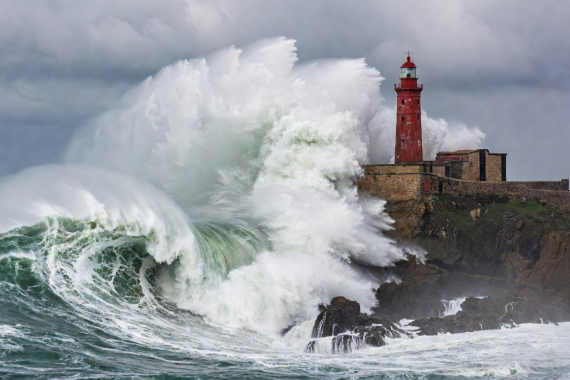
Shift 150 kilometers west to the Atlantic shoreline, and tranquility is replaced by the raw, thunderous power of Nazaré. Once a quiet fishing town where fishermen wore traditional checked wool shirts and women wore seven layered flannel skirts (as sete saias), Nazaré has become the global capital of extreme big-wave surfing.
The mechanics behind Nazaré’s monstrous waves lie concealed underwater in the Canhão da Nazaré—Europe’s largest submarine canyon. Reaching depths of 5,000 meters and extending 227 kilometers from the ocean abyssal plain right up to Praia do Norte, the canyon functions as a massive funnel:
- Wave Amplification: As oceanic winter swells enter the canyon, the wave traveling through deep water retains high velocity, while the wave over the shallow continental shelf slows down.
- Constructive Interference: When the two split wave components meet near the headland of Sítio, they collide and combine, doubling their vertical amplitude and exploding upward into colossal peaks exceeding 80 feet (24 meters).
Observing Big Waves at Forte de São Miguel
Giant swell season runs from mid-October through March. Big waves occur during specific North Atlantic winter storm cycles and require swell periods exceeding 14 seconds combined with light offshore winds. When conditions align, the headland around the red lighthouse at Forte de São Miguel Arcanjo provides the most exhilarating spectator viewpoint on the planet.
Traditional Nazaré: Sítio and the Beach Front
Even outside the winter big-wave season, Nazaré offers compelling heritage. Take the historic 1889 funicular railway linking the beachfront promenade to O Sítio, perched on a 110-meter sheer cliff. Visit the Sanctuary of Our Lady of Nazaré and watch traditional fishwives salt and sun-dry horse mackerel (carapau) and octopus on wooden mesh racks along the sand, preserving centuries of coastal Atlantic subsistence culture.